
Type 1 Diabetes in Children: Warning Signs Parents Miss

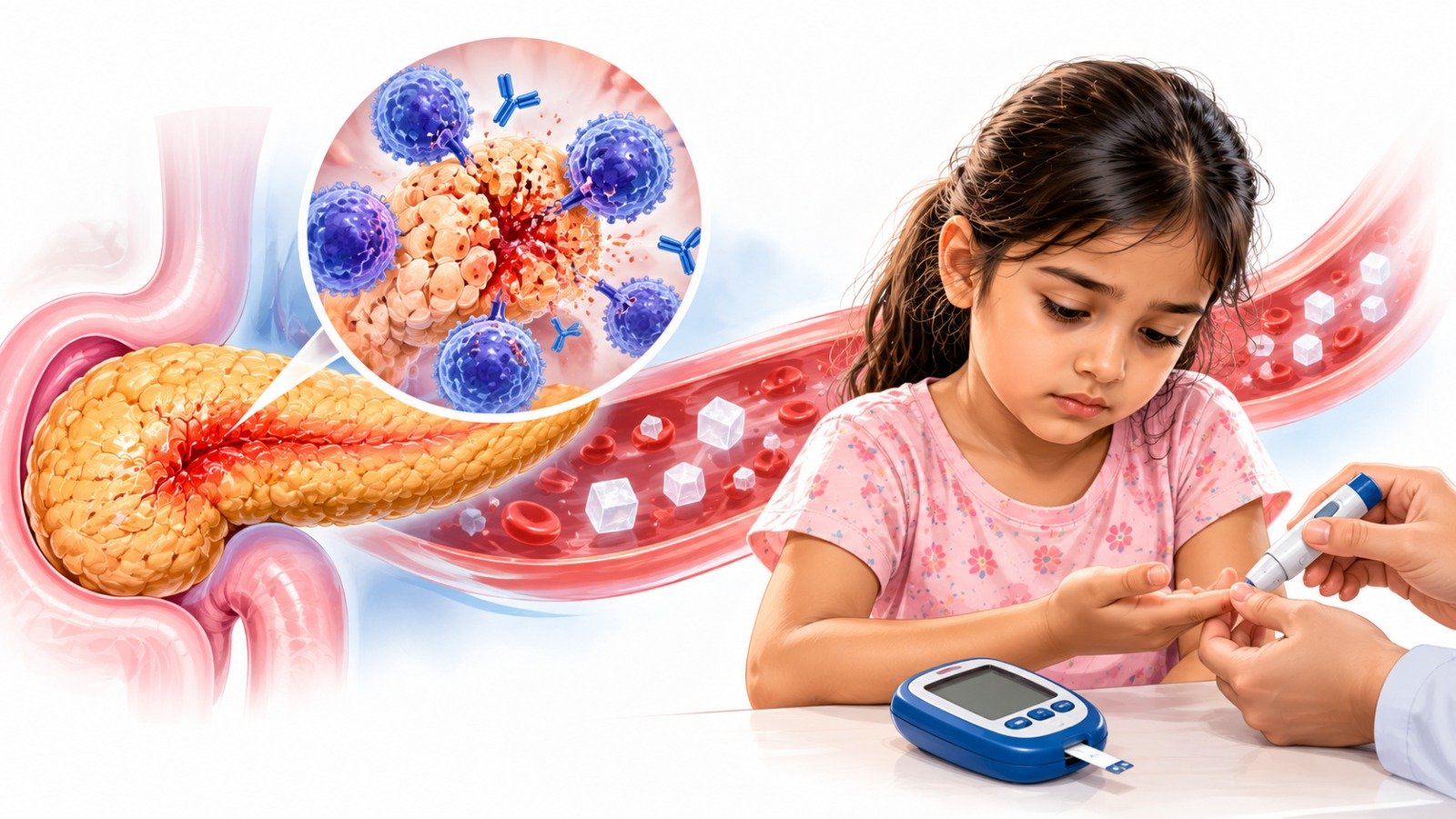
Type 1 diabetes is not caused by how many sweets a child eats. It is an autoimmune condition in which the body's own immune system destroys the insulin-producing cells in the pancreas. Without insulin, glucose stays in the bloodstream instead of fueling the body's cells.
What makes it dangerous in children is speed. Type 1 diabetes can develop over just a few days to a few weeks, and the first signs are easy to mistake for everyday childhood problems. When they are missed, the first presentation can be a hospital emergency. Knowing what to look for can shorten the journey from "something is off" to a diagnosis that keeps your child safe.
1. The Classic Signs That Get Brushed Off
Type 1 diabetes in children classically appears as a cluster of signs that parents often connect to summer heat, exam stress, or a viral infection. In medical teaching they are summarised as the "4 Ts" — thirsty, toilet, tired, thinner.
Early warning signs parents notice first
- Drinking far more water than usual, and crying for water at night
- Frequent urination, including a child who suddenly needs the bathroom repeatedly
- Losing weight without trying, even while eating normally or more than usual
- Constant tiredness — falling asleep during the day, refusing to play, or wanting to be carried
- Irritability, mood swings, or a sudden drop in school performance
- Blurred vision, showing up as squinting or sitting too close to the television
- Repeated thrush, fungal nappy rashes, or small wounds that heal slowly
These symptoms overlap almost perfectly with conditions Indian families see constantly — dehydration in summer, weakness during exam season, "gas and acidity", or a lingering viral fever. The difference is that with type 1 diabetes the signs keep intensifying over days rather than settling. When thirst and urination keep escalating, sugar testing should happen the same day.
2. Sudden Bedwetting in a Child Who Was Dry
One of the most telling signs is also the most dismissed. A child who has been toilet-trained for years and starts wetting the bed again — often soaking through, and thirsty every night — may be passing large volumes of diluted glucose in the urine. Secondary nocturnal enuresis after a dry period is a well-recognised early signal of type 1 diabetes.
Families frequently respond with scolding, bedtime fluid restriction, or waiting it out. If bedwetting returns alongside increased thirst or weight loss, it is a reason for a blood glucose test, not a discipline problem.
3. When Vomiting and Fast Breathing Mean Emergency
When the body cannot use glucose, it burns fat instead, producing acidic compounds called ketones. Built up too far, ketones cause diabetic ketoacidosis (DKA) — a life-threatening emergency that is still, in many settings, how type 1 diabetes first reveals itself. Studies commonly report that around one in three children are already in DKA at diagnosis, and the figure is higher in many countries where early symptoms are missed.
Signs of diabetic ketoacidosis — go to a hospital immediately
- Vomiting, or stomach pain that comes and goes
- Deep, rapid, laboured breathing (called Kussmaul breathing)
- A fruity or nail-polish-like smell on the breath
- Extreme sleepiness, confusion, or difficulty waking the child
- Dehydration with dry lips, sunken eyes, and no urine for hours
Any combination of these with known or suspected diabetes is a medical emergency. Do not wait for a laboratory appointment — an emergency department can start fluids and insulin within minutes.
4. Why Type 1 Diabetes Gets Mistaken for Other Things
Two myths cause most of the delay. The first is the belief that a child developed diabetes "because of too much sugar." Type 1 diabetes is autoimmune — eating sweets does not cause it, and cutting sweets will not stop it. The second is the assumption that diabetes only affects adults, or only "older people in the family."
Because of these myths, children are often treated at home for weakness or infection for days before anyone checks a glucose reading. Medical studies from India report that a significant proportion of children are already in DKA when type 1 diabetes is finally identified — a delay that almost always traces back to symptoms being explained away early on.
5. Who Is at Risk, and How Doctors Confirm It
Type 1 diabetes accounts for roughly 5 to 10 percent of all diabetes cases and is the most common form diagnosed in children and teenagers. It can appear at any age, including in toddlers.
Higher-risk situations
- A sibling or parent with type 1 diabetes — close relatives carry several times the background risk
- Another autoimmune condition, such as thyroid disease or coeliac disease
- Classic symptoms appearing over days to weeks, regardless of family history
Confirmation is straightforward and fast. A capillary fingerstick gives an immediate clue; laboratory criteria used worldwide (American Diabetes Association) confirm the diagnosis with a fasting glucose of 126 mg/dL or above, an HbA1c of 6.5 percent or above, or a random glucose of 200 mg/dL or above with symptoms. A urine or blood ketone test tells the doctor how urgent the situation is. In unclear cases, autoantibody tests (such as GAD65, IA-2, ZnT8 and insulin autoantibodies) demonstrate that the condition is autoimmune — distinguishing type 1 from type 2 in children, which matters because their treatments differ.
6. What Parents Should Do If They Suspect It
- Get a blood glucose test the same day — fasting, random, or HbA1c at any decent laboratory, often with results within hours
- Ask for a ketone test if your child is vomiting, breathing fast, or very drowsy — and treat it as an emergency if so
- Write down the timeline: when thirst started, how weight has changed, how often the child urinates — this helps the doctor enormously
- Insist on a paediatric diabetologist or endocrinologist consultation if the first opinion dismisses persistent symptoms
- Never wait for the "next annual check-up" when symptoms are active
Final Takeaway
Type 1 diabetes in children moves fast, but its warning signs are visible: escalating thirst, frequent urination, unexplained weight loss, renewed bedwetting, and tiredness that does not lift. When vomiting, rapid breathing or drowsiness join them, it is an emergency. A simple glucose test resolves the question in hours — and early diagnosis is what turns a hospital emergency into a manageable condition. Trust what you see in your child, and test rather than guess.
Sources and References
- American Diabetes Association — Standards of Care in Diabetes: classification, diagnostic criteria and DKA management (diabetesjournals.org/care)
- International Society for Pediatric and Adolescent Diabetes (ISPAD) — Clinical Practice Guidelines (ispad.org)
- World Health Organization — Diabetes fact sheet (who.int)
- ICMR–INDIAB — National prevalence survey of diabetes in India (icmr.gov.in)
- RSSDI (Research Society for the Study of Diabetes in India) — Clinical practice recommendations (rssdi.in)
Medical disclaimer: This article is for information and education only. It does not replace examination, diagnosis or treatment by a qualified doctor. If your child has symptoms described here, consult a physician or visit a hospital without delay.
Looking for a Diabetes Specialist Near You?
Consult verified diabetologists for HbA1c control, personalized diet management, insulin therapy, and complications screening. Direct clinic contacts and WhatsApp assistance — zero booking fees.